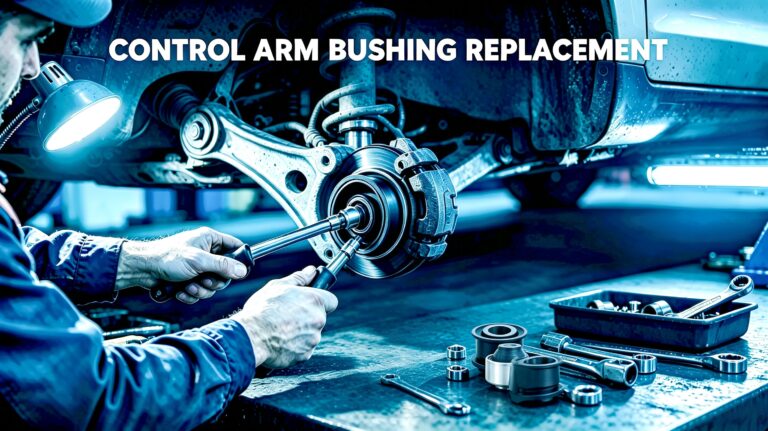
Learn to distinguish control arm bushing vs ball joint failure by noise, steering feel, and tire wear. This guide covers safe DIY inspection methods, safety risks, and repair strategies to avoid costly misdiagnosis.
Quick Answer
If you need a fast rule of thumb: worn bushings typically cause dull thuds, creaks, or vibrations over bumps, while bad ball joints often produce sharp metallic clicking, popping during steering, or a feeling of looseness in the front end.
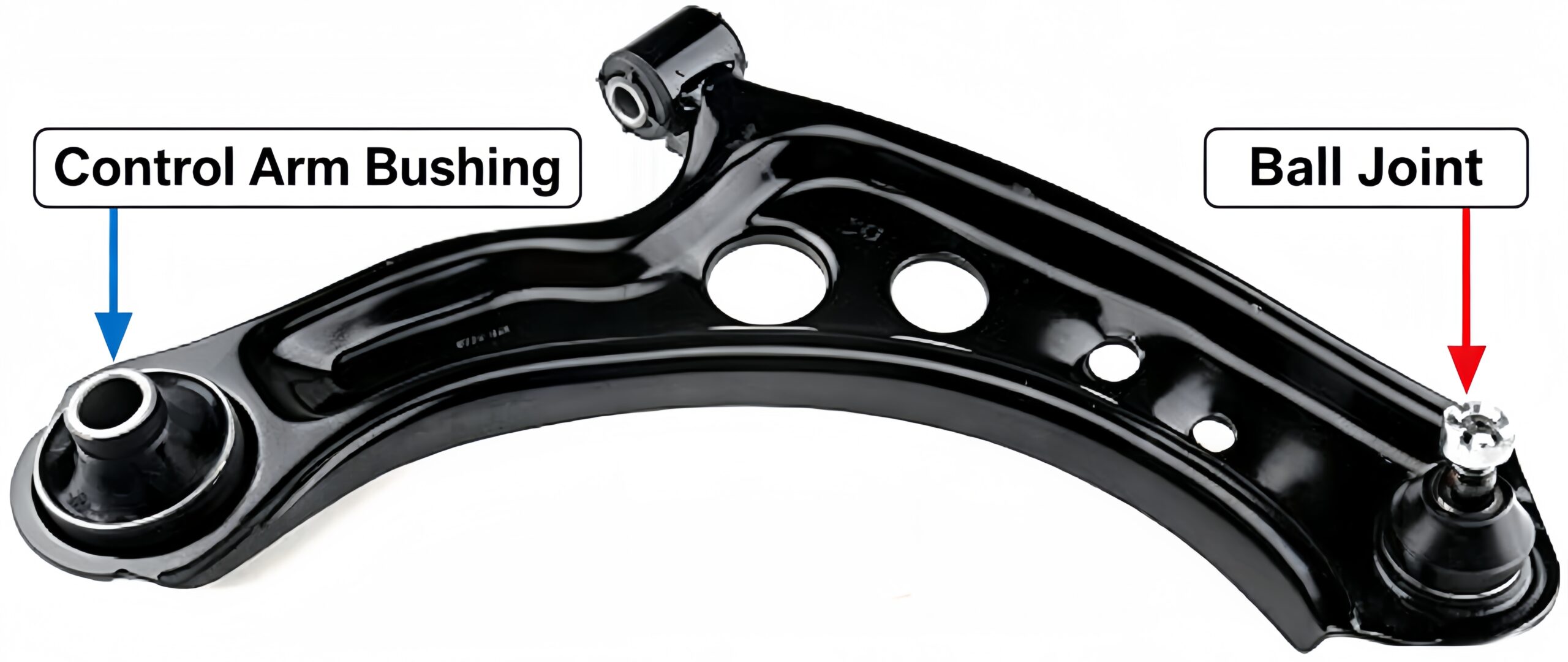
However, there is a critical caveat for modern vehicles. Many newer cars feature integrated designs where the ball joint is riveted or pressed permanently into the control arm. In these cases, even if only the ball joint has failed, you cannot replace it individually. You must replace the entire control arm assembly.
Quick Diagnostic Breakdown: Bad Bushing vs. Ball Joint
To quickly isolate your front-end noise, compare your vehicle’s symptoms against the key differences below:
| Diagnostic Feature | Worn Control Arm Bushing | Worn Ball Joint |
|---|---|---|
| Primary Sound | Creaking, squeaking, or a soft rubber-to-metal thunk | Metallic clunking, snapping, popping, or high-pitched screech |
| Trigger Event | Going over speed bumps, driveway inclines, or heavy braking | Turning the steering wheel, driving on rough roads, weight shifts |
| Failure Mechanism | Cracked, dry, or torn rubber sleeve; leaking hydraulic fluid | Damaged dust boot letting grease leak out, causing metal friction |
| Handling Symptoms | Steering drift under braking, excessive fore-aft tire shift | Loose/wandering steering, uneven inner or outer tire edge wear |
| Safety Urgency | Moderate (accelerates tire wear and alignment degradation) | Critical (risk of joint separation and total wheel detachment) |
Is It Safe to Keep Driving with Suspension Noise?
The answer depends on which specific component is failing and the severity of the damage.
- Driving on a Worn Bushing: If the rubber bushing is merely dry or cracked, short-distance, low-speed driving is generally manageable. However, prolonged driving will accelerate tire wear, ruin wheel alignment, and put additional stress on nearby suspension links like strut mounts and sway bar end links.
- Driving on a Worn Ball Joint: This is a severe safety hazard. A dry ball-and-socket joint can bind and snap under load. If a ball joint fails completely while driving, the control arm will disconnect from the steering knuckle, causing the tire to drop and collapse into the wheel well. If you hear loud popping noises or feel significant wheel play, stop driving immediately and inspect the joint.
Should You Replace the Bushing, Ball Joint, or the Entire Control Arm?
Once you pinpoint the failing part, you must decide whether to replace individual components or install a complete loaded control arm assembly.
Replacing Individual Bushings or Ball Joints
Pressing out an old bushing or ball joint requires specialized hydraulic press tools and press sleeves. This method is labor-intensive, requires high operating precision, and is difficult to perform without removing the arm entirely. If the original control arm body has internal metal fatigue, rust, or bending, pressing new parts into aged metal eyelets can lead to loose press fits or component failure down the road.
Replacing the Entire Control Arm Assembly (Recommended)
On most modern vehicles, lower ball joints are riveted, welded, or permanently cast into the control arm by original equipment (OE) manufacturers and cannot be servicing separately. For these designs, replacing the complete control arm assembly is the standard, safe, and cost-effective solution.
- Saves Time & Labor: Replacing a loaded arm requires simple hand tools and bolt-on installation, avoiding the high shop labor cost and frustration of pressing out rusted parts. Many repair shops will not press standalone ball joints due to warranty risks, making full arm replacement more economical overall.
- Total Chassis Renewal: Installing a complete assembly replaces both the inner bushings and the outer ball joint at the same time, preventing the second old part from failing shortly down the road.
- Purchasing Tips: Always verify that the new control arm assembly includes pre-installed high-density bushings, a pre-greased ball joint, and fresh hardware—avoiding “bare arms” that lack critical wear components. Choose OE-spec replacement parts from reputable aftermarket brands made with high-grade steel or forged aluminum to prevent premature rubber cracking or joint binding.